
New to FM27? These 12 tips cover tactics, training, scouting and squad building, plus the mistakes to avoid before your first match.
FM27 tips: 12 things to do before your first match
The first hour of an FM27 save decides more than most players admit. Not because the match engine is unfair, but because a club with the wrong tactical shape, an overloaded training schedule and three panic signings takes half a season to repair. The tips below are the setup work worth doing before you press Continue for the first time.
This is not a list of magic tactics. It is a checklist for new managers and for anyone returning from FM26 who wants to avoid carrying old habits into the rebuilt interface. Every recommendation is about giving your squad a clear job, then letting the match engine show you what it can and cannot do.
Pick a club that matches your patience, read the board's expectations, hire staff before signing players, choose one tactical identity, and use the Tactical Effectiveness gauge as a diagnostic. Do that before your first competitive match and the season becomes much easier to read.
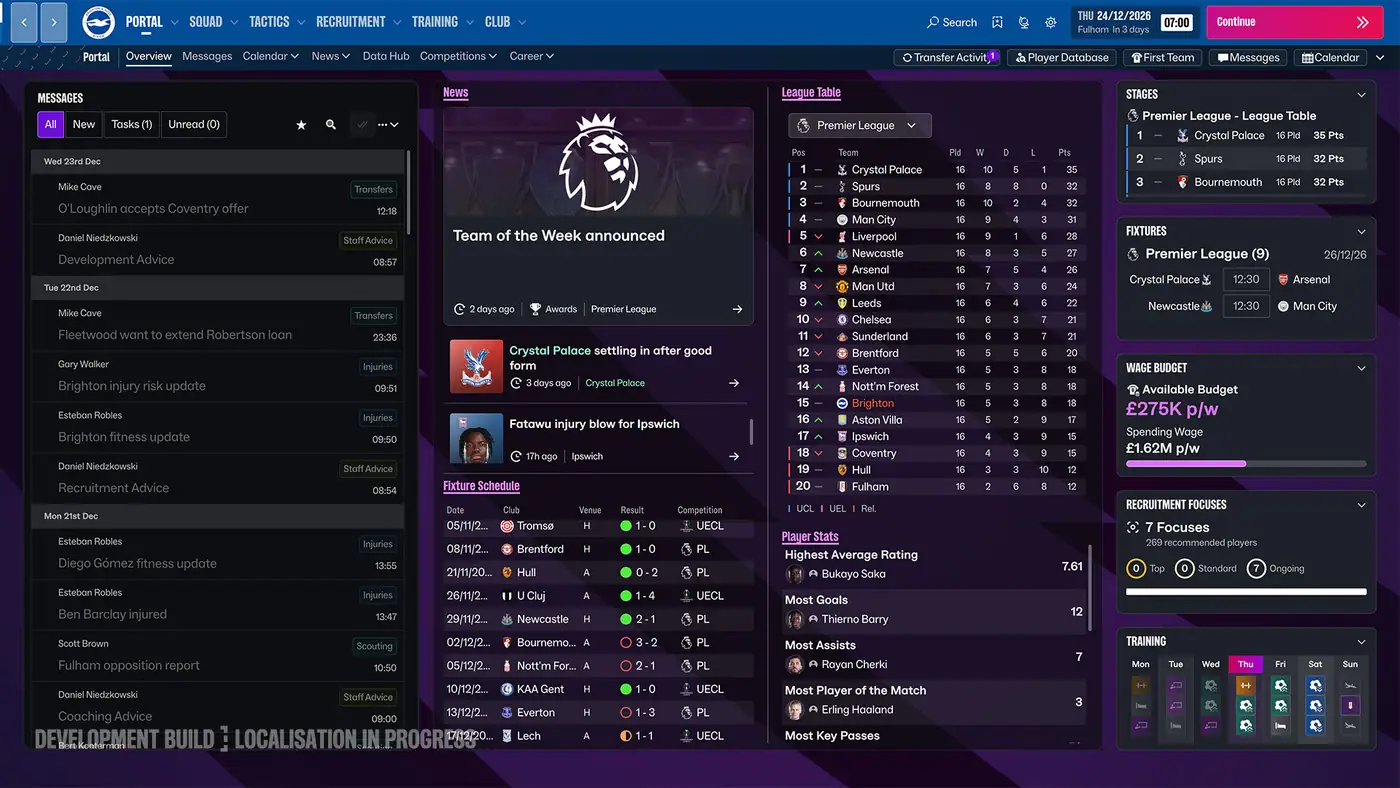
Before you pick a team
1. Choose a club that matches your patience
The biggest early mistake is taking a title contender and treating it like a project, or taking a lower-league side and expecting instant possession football. Decide what kind of save you want before you look at the job list.
A top club gives you money, better staff and players who can execute complex instructions. It also gives you a board that expects results now. A lower-league club gives you time and a squad with obvious weaknesses; the lower-league guide explains how to survive the first season. Neither is harder in the abstract. They ask for different kinds of decisions.
2. Read the board's expectations before you spend
Open the club vision and board expectations screens before the transfer market. The board tells you which competitions matter, what league position is acceptable and whether youth development or financial restraint is part of the job. Those targets shape your transfer policy more than a star rating does.
If the board expects a top-half finish and you spend the budget on one ageing forward, you have traded long-term flexibility for a short-term headline. If the board expects survival, a squad full of promising teenagers may be the wrong gamble. Write the target down and check your plans against it.
3. Hire the staff before the players
Staff are cheaper than players and they affect more of the game than most new managers realise. An assistant manager who can assess your squad, coaches who cover the training areas you actually use, and scouts who can find players in the markets you care about are all worth more than a fourth-choice striker.
The FM27 staff guide explains which attributes matter for each role. The short version: do not hire a famous name with a poor working relationship with your squad, and do not leave scouting uncovered while you chase a marquee signing.
4. Decide your tactical identity before buying anyone
Choose a base shape and a way of playing that your current squad can already approximate. Then sign players who improve that plan. Doing it the other way round — buying talented individuals and hoping a system appears — is how squads become unbalanced.
A simple starting point is one formation with two or three tactical instructions you understand. You can add complexity later. The FM27 formations guide compares the shapes, and the best tactics page shows how the systems are built rather than offering a plug-and-play download.
Tactics and match day
5. Build roles and duties before instructions
A formation is only a picture until you assign roles and duties. A midfielder on Defend, Support or Attack behaves differently even in the same slot, and the combination of duties creates the shape during buildup.
Start with a role for every player that matches their attributes, then adjust duties so the team has cover behind the attacks. If your best player is an attacking full-back, give the midfielder on that side a more conservative duty. The FM27 tactics guide walks through the logic; the tactical effectiveness guide explains how the game scores the result.
6. Use Tactical Effectiveness as a diagnostic, not a score
Tactical Effectiveness is not a "higher is always better" meter. It tells you how well your squad can execute the instructions you have set. A low score can mean the players lack the attributes, the instructions conflict, or the roles do not fit together.
Use it to find the specific problem. If the score drops when you add a high line, your defenders may lack the pace or anticipation to play it. If it drops when you ask for more pressing, your midfield may be too slow to recover. Change one thing, check the gauge, then decide. Do not keep adding instructions until the number turns green.
7. Watch a full match in 2D before you change everything
Highlights show you goals and near-misses. They do not show you why your midfield keeps getting bypassed. Watch at least one full match in 2D, ideally at a moderate speed, and look at the shape rather than the ball.
Ask three questions: Is there a gap between defence and midfield? Is the striker isolated? Does the team lose the ball in the same area every time? Those patterns are easier to see in 2D than in a highlight reel. The official FM27 feature set includes a reworked 2D match engine, so it is worth using as an analysis tool rather than a fallback.
8. Set up set-piece routines early
Set pieces are a reliable source of goals for teams that cannot outplay opponents, and they are easy to neglect. Spend twenty minutes on corners, wide free kicks and defensive marking before the first competitive match. Assign your best headers and your best deliverers, then test the routine in a friendly.
The FM27 set pieces guide covers routines and delivery. The key principle is repetition: a simple near-post corner that your squad understands beats a complicated routine that produces a chance once every five matches.
Squad and season management
9. Set training to match preparation, then adjust
The rebuilt training module is powerful enough to overload a squad. Start with a schedule that prepares for the next opponent and keeps recovery sensible, then add individual work for the players who need it. Do not set every session to high intensity in the first week.
The FM27 training guide explains match preparation, rest and individual focus. Watch the medical and fitness screens after the first few sessions. If half the squad is jaded, the schedule is too heavy regardless of what the coaches recommend.
10. Scout for roles, not names
A familiar name is not a scouting report. Send scouts to watch players who fit the role you actually need, and compare their attributes against the demands of your system. A winger with great dribbling but no end product may be a highlight player rather than a solution.
The FM27 scouting guide covers assignments and knowledge. Build a shortlist with three options per position: a first choice, a cheaper alternative and a loan or free-agent fallback. That way one rejected contract does not derail your window.
11. Protect the wage budget
Transfer fees get the attention; wages decide whether you can react in January. A squad with a few overpaid backups has no room for an injury replacement. Check the wage budget before every signing, and be willing to walk away from a deal that leaves no margin.
Free agents and loans are the best way to add depth without a fee, but they still carry wages. The FM27 transfers guide and free agents page explain the market. A short-term loan with a sensible wage contribution is often better than a permanent signing you cannot move later.
12. Manage morale and rotation before it becomes a crisis
Dynamics is not a cosmetic screen. Player happiness affects training, dressing-room atmosphere and how players respond to criticism. Rotate before your starters are exhausted, praise good training form, and deal with a public complaint before it spreads.
The official FM27 feature set puts more emphasis on squad dynamics and player personalities. The practical routine is simple: check the Dynamics screen once a week, talk to unhappy players early, and do not criticise a player in public unless you are prepared for the reaction. A settled squad with average talent usually beats a talented squad that dislikes the manager.
Your first-week checklist
| When | Action | Why it matters |
|---|---|---|
| Day 1 | Read board expectations and club vision | Sets the target you are actually judged on |
| Day 1 | Hire assistant, coaches and scouts | Staff quality affects assessment and development |
| Day 2 | Choose a base formation and roles | Gives the squad a clear job before transfers |
| Day 2 | Check Tactical Effectiveness | Finds attribute or instruction conflicts early |
| Day 3 | Set training and rest | Prevents a self-inflicted fitness crisis |
| Day 4 | Build a shortlist by role | Avoids panic buying after a rejected bid |
| Pre-match | Set set-piece routines | Adds a repeatable source of chances |
| Weekly | Check Dynamics and wages | Catches morale and budget problems early |
FAQ
What is the best tactic for a new FM27 save? There is no single best tactic without a squad. Start with a balanced shape your players can execute, check Tactical Effectiveness, and adjust one instruction at a time. The best tactics page shows three systems you can build in twenty minutes.
Should I start with a big club or a lower-league club? A big club is easier if you want to learn the match engine with good players. A lower-league club is better if you enjoy recruitment and squad building on a small budget. Pick the challenge you will still enjoy in February.
How important is Tactical Effectiveness? It is a useful diagnostic, not a win button. A high score means your squad understands the instructions; it does not guarantee results against a stronger opponent. Use it to find conflicts, then trust the match.
Do I need the in-game editor? No. The pre-game editor is included for database changes, and the in-game editor is a separate purchase. Neither is required to manage a club. The FM27 editor guide explains the difference.
How many leagues should I load? Load the leagues you will actually scout and the ones that affect your competition. More leagues make the world feel alive but slow processing. The system requirements page explains which component matters for processing speed.
What to read next
- FM27 tactics guide for the full tactical model.
- FM27 best tactics for three buildable systems.
- FM27 training for schedules and match preparation.
- FM27 scouting for assignments and shortlists.
- FM27 transfers for fees, wages and negotiations.
Sources
- Football Manager 27 features — official feature overview, including Tactical Effectiveness and the match engine.
- FM27: Training and Tactical Effectiveness — official deep dive.
- FM27 on Steam — release, requirements and store details.
- Sports Interactive — developer information.
More Football Manager 27 Guides
The best FM27 wonderkids outside the big-five leagues, sorted by wage tier, with the clubs that sell and the ones that do not.
FM27 Console is out on PS5 and Xbox Series X|S. Here is how it differs from the PC version, what Game Pass Ultimate includes, and what is still unconfirmed.
FM27 contracts still revolve around wages, clauses and agent fees. Here is how to read the deal sheet, time a renewal and avoid a wage-bill disaster.
The FM27 Demo is free on Steam and gives you six in-game months. Here is how it works, what carries into the full game and what it does not include.
FM27 editor guide: pre-game editor vs in-game editor, how to install real name and logo fixes, and what custom databases change in a save.
Five FM27 formations compared by pressing lanes, role demands and tactical complexity, from 4-2-3-1 to a back three.
The FM27 free agent list worth signing: 34 players without a club, their ages, positions and what each one still does well.
The FM27 Steam free weekend ran from 29 October to 3 November 2026. Here is what it included, what replaced it, and how to play now.